AI Is Teaching Buyers About You Before Your Website Can
Companies spend months arguing over the words on their homepage because they assume that is where buyers learn who they are.
A growing number of buyers will never start there.
They will ask AI what your company does, whether you belong on their shortlist, how you compare with competitors and what concerns they should have. The answer may use your website, but it will also use reviews, articles, competitor claims, old information and whatever the system already believes about your category.
Your homepage is no longer the introduction. It is one source inside an introduction written by someone else.
And the most dangerous part is that the buyer may never realize how much was missing.
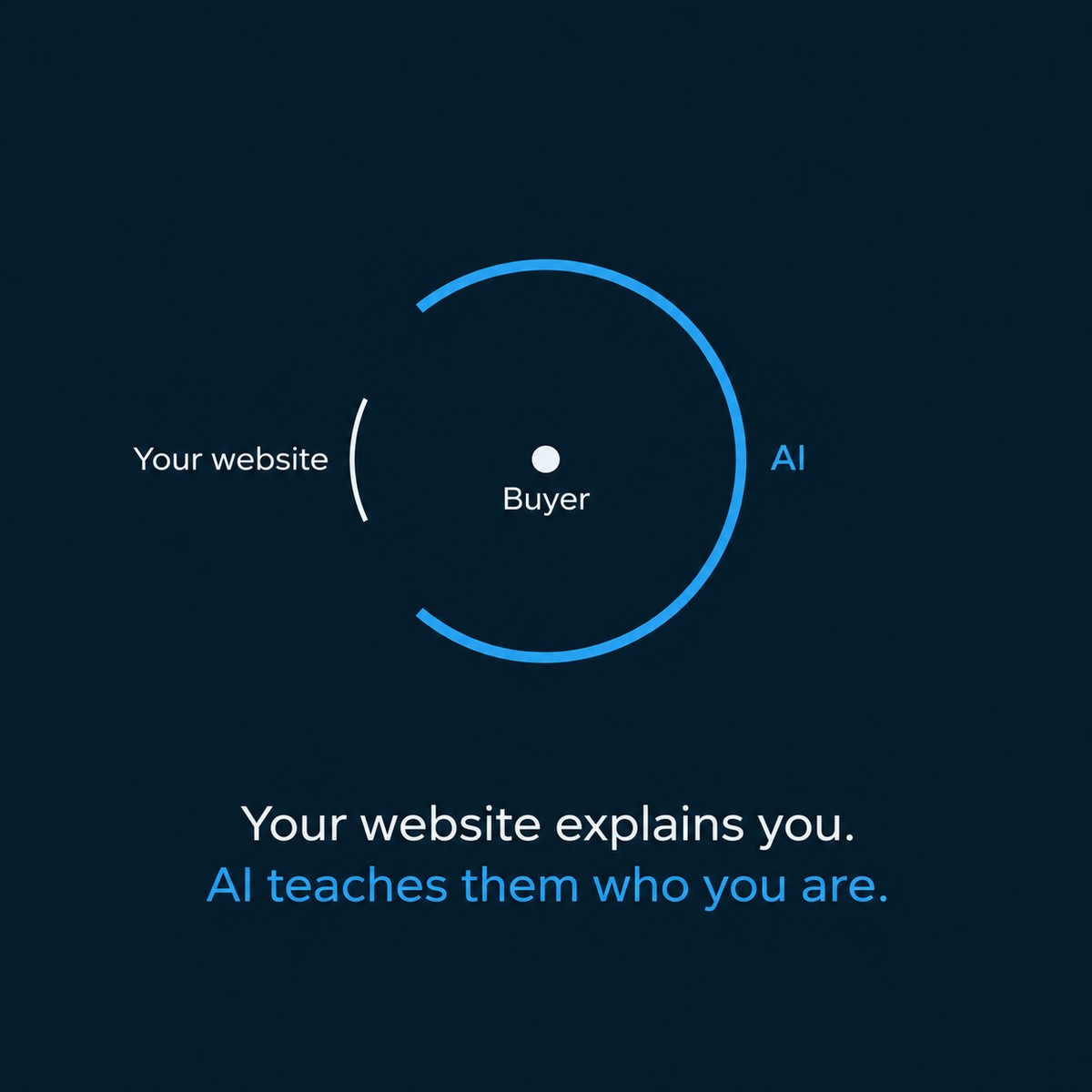
You can still control what you publish. You cannot control which parts AI considers important enough to teach.
Your website is no longer the first teacher
The old model gave companies enormous control over the sequence. The homepage established the category. Product pages explained the offer. Case studies provided proof. Sales filled in whatever the buyer still did not understand.
AI changes the order.
The buyer begins with their own language and their own questions. AI decides what information seems relevant, which sources deserve attention and how the market should be explained. It may introduce your company beside competitors you would never choose. It may use an old description, miss an important service or reduce years of differentiation to the same generic sentence it uses for everyone else.
By the time a buyer reaches your site, the first lesson may already be finished.
This behavior is not sitting on the edge of B2B buying anymore. G2 reported in 2026 that 51% of B2B software buyers begin their purchasing research in an AI chatbot, up from 29% in its previous reporting. Seventy-one percent use AI chatbots somewhere in the research process.
That means the first version of your category, your company and your competitors is increasingly being taught before your website gets a chance.
AI does not repeat your story. It assembles one.
It is tempting to picture AI reading your homepage and producing a shorter version. That is not what buyers are receiving.
AI builds a composite explanation. It mixes what you say with what others say about you, what competitors say about the market, what reviewers emphasize and what the model already associates with the category. Then it rewrites all of that in response to the buyer’s specific question.
The output can be useful. It can also erase nuance, elevate the wrong comparison or confidently leave out the one difference your sales team considers essential.
| Company-controlled introduction | AI-assembled introduction |
|---|---|
| Uses the company’s preferred language | Translates the company into the buyer’s language |
| Presents positioning in a planned sequence | Pulls together whichever facts appear relevant |
| Emphasizes chosen differentiators | Compares them with competitor claims |
| Controls which proof appears | Evaluates company and third-party evidence together |
| Can avoid uncomfortable comparisons | May introduce weaknesses, alternatives and objections immediately |
Your site is only part of the curriculum
Your website still matters. In fact, strong company content gives AI something accurate and useful to work with. But your site does not get the only vote.
Resonance analyzed more than 1.3 million citations in AI answers about 116 B2B technology brands. Eighty-three percent pointed to company websites—but 66% went to other companies’ sites and only 17% went to the brand’s own site.
The gap became even more important when the buyer had not named a brand. On unbranded category and problem questions, only 6% of citations went to the eventual brand’s own website. When the buyer named the brand, that increased to 29%.
In other words, your website has a much stronger chance of explaining you after the buyer already knows you. During the category questions where shortlists begin, competitors, consultants and other companies may be doing more of the teaching.
Your website is not irrelevant. The market surrounding it has become part of your messaging whether you approved it or not.
“You don’t sell the first impression anymore. AI does. Before your homepage loads or a sales deck is opened, an AI tool has already summarized you based on what it could find, interpret, and compress.”
— Andy Halko, The Omniscient Buyer
AI is teaching buyers five things about you
The answer is doing more than producing a company description. It is teaching the buyer how to evaluate you.
Category
What kind of company are you, and which problem does AI believe you solve?
Relevance
Which use cases, industries, company sizes and situations make you appropriate?
Difference
What does AI believe separates you from the other companies it could recommend?
Risk
Which limitations, complaints, pricing concerns or implementation challenges should the buyer consider?
Proof
Which results, customers, reviews and outside sources make your claims believable?
A weak answer in any one of these areas can change the shortlist. If AI places you in the wrong category, the buyer may never see your relevance. If it cannot identify a difference, price becomes more important. If it finds claims without proof, it may hedge or favor a competitor with stronger evidence.
The incomplete answer may sound completely trustworthy
An obviously bad answer is annoying, but it is easier to correct. The buyer sees the mistake and keeps researching.
The real danger is an answer that is mostly right.
It may describe your service accurately while omitting a major capability. It may cite a limitation you solved two years ago. It may compare your premium offer with a competitor’s entry-level product. It may use the right facts but arrange them around the wrong conclusion.
The buyer receives a polished explanation with clear language and apparent balance. Nothing signals that an important piece is missing.
The danger is not only that AI gets your company wrong. It is that it gets you wrong in a response that sounds researched enough to trust.
This is why AI-generated brand perception deserves leadership attention. A distorted introduction can affect who researches you, what they expect, which questions they ask and whether they decide you are worth a conversation.
Publishing more generic content will not fix this
The predictable response will be to create hundreds of pages aimed at prompts, categories and long-tail questions. Volume feels productive because it is easy to count.
But AI cannot preserve a distinction your company has never expressed clearly enough to recognize.
Publishing more interchangeable content gives the system more words, not a stronger understanding. The useful work is harder:
- Define the category and problems you want to own
- State your differences in language that can survive a summary
- Support important claims with concrete evidence
- Keep product, service and company facts current
- Build consistent authority across owned and independent sources
- Answer the questions buyers actually ask, including uncomfortable ones
The goal is not to dictate the answer. You cannot. The goal is to make the important truths about your company difficult to miss and easy to verify.
Insivia’s answer engine optimization work helps companies shape what AI systems can retrieve, understand and repeat about their expertise.
What companies should do now
Define what AI must understand
Document the category, audience, difference, proof and boundaries that must survive any summary.
Audit the current lesson
Ask realistic buyer questions across major AI systems and record what is included, omitted, distorted and sourced.
Build a consistent evidence environment
Align website content, executive viewpoints, product facts, external profiles, reviews and earned authority.
Prepare the site to validate
The buyer who arrives may already feel informed. Give them clear proof and a fast way to confirm—or correct—what AI taught them.
Insivia’s buyer-centric website playbooks show how to build a site that deepens, proves or corrects the understanding a buyer formed before visiting.
You are no longer the only author of your introduction
Your company will keep writing its own story. The mistake is assuming buyers will encounter that story in the form you wrote it.
AI is already teaching them what category you belong in, whether your claims are believable and which competitors deserve attention. It is doing that with a curriculum assembled from the entire market.
This is why AI-mediated awareness is bigger than a traffic shift. The click may be disappearing, but the interpretation still happens. And when buyers finally reach your site, they may arrive with more intent and stronger assumptions than your traditional visitor.
You do not need complete control over the answer. You need enough authority, clarity and evidence that the important parts of your company survive the interpretation.
Influence the lesson before the buyer arrives
Find out what AI is already teaching buyers about your company.
Explore the full argument in The Omniscient Buyer, bring this shift to your leadership team or use BuyerTwin to examine how AI-influenced buyers understand your market.

