AI Is Filtering Your Website Traffic Before You See It
Companies have trained marketing teams to panic when website traffic falls. Fewer visits must mean less awareness, weaker demand or a content strategy that has stopped working.
AI is making that conclusion dangerous.
A buyer can now investigate the problem, learn the category, compare approaches and narrow the field without creating a single session in your analytics. If they eventually visit your site, they may not be looking for an introduction. They may be checking whether you deserve to remain on a shortlist they already built.
Your traffic report can get worse while the quality of your buyers gets better.
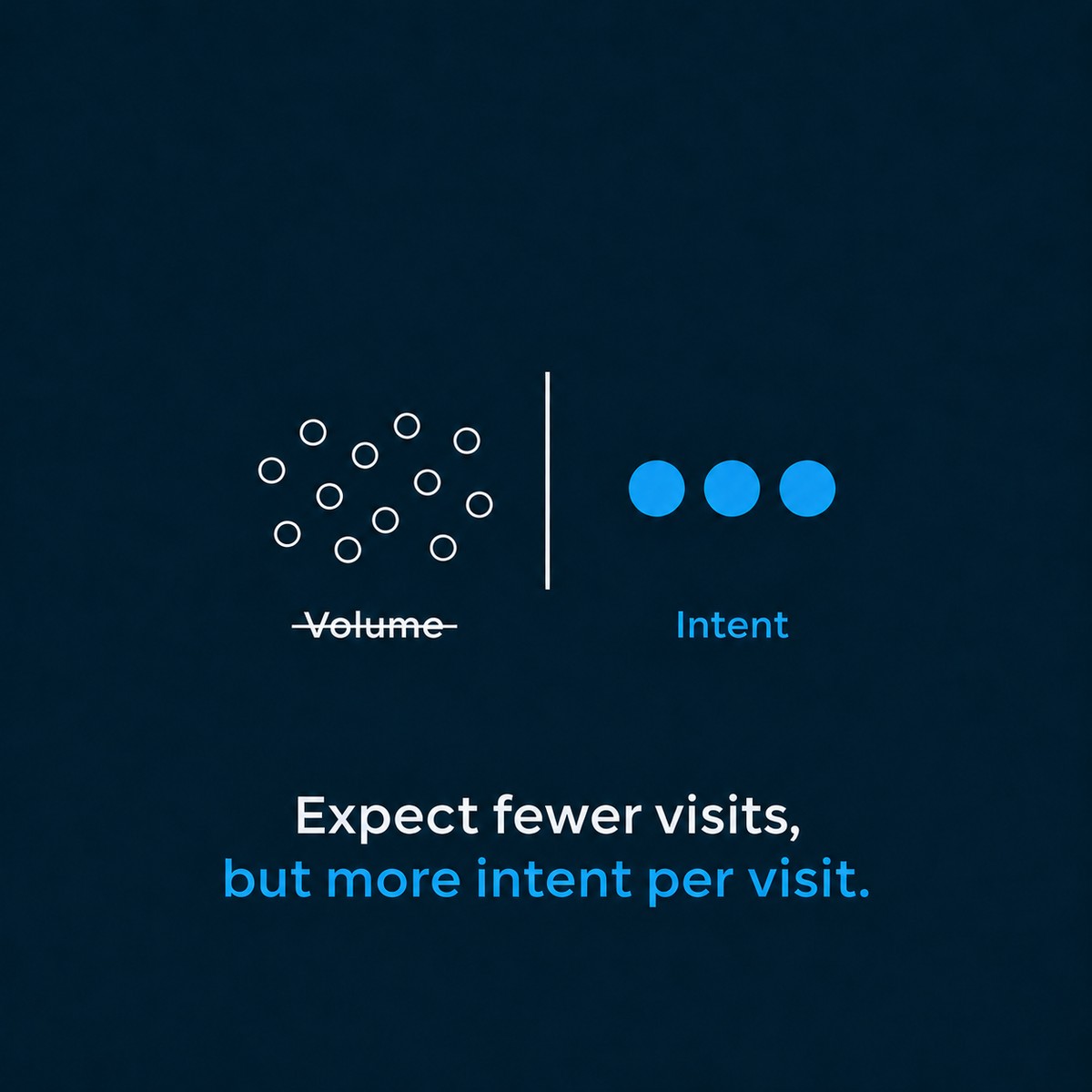
AI is creating a pre-click qualification layer. It will not make every visitor high-intent, but it can remove more of the education and comparison work that once happened on your website.
The casual research visit is moving somewhere else
For years, websites did a large amount of early buying work. Someone searched a broad question, landed on an article, learned the vocabulary and clicked through a few pages. They might have been months from a decision—or not buying anything at all—but the visit still appeared in the same analytics report as a serious evaluator.
AI can absorb much of that wandering.
The buyer can ask one system to explain the problem, identify solution categories, compare vendors, surface common objections and suggest what to investigate next. They may never see the ten pages that informed the answer. They may not know which companies were considered and discarded along the way.
When a click finally happens, it can happen later. The visitor may know your category, recognize your competitors and carry criteria you had no role in creating.
That is not simply less traffic. It is a change in who the traffic represents.
| Traditional website visitor | AI-influenced website visitor |
|---|---|
| Arrives to understand the problem | May arrive with a working diagnosis |
| Learns the category on the site | May already understand the category |
| Discovers alternatives gradually | May arrive with a shortlist |
| Develops criteria while browsing | May judge the site against preformed criteria |
| Needs broad education | Wants fit, proof and specifics |
The traffic loss and the quality gain can happen together
The early data does not support a simplistic claim that every visitor from AI is ready to buy. It does show that the composition of traffic is changing.
Contentsquare reported that conversion from AI-referred traffic increased 55% year over year to 1.3%. That was the only channel in its benchmark showing conversion growth, but it still converted below most established channels. The direction is significant. The conclusion needs restraint.
Similarweb found a stronger result on transactional sites: U.S. referrals from generative AI converted at roughly 7%, compared with about 5% from Google, while also producing more time on site and more pages viewed.
Those findings are not contradictory. They show that traffic quality depends on the market, the buyer, the task and how conversion is defined. AI can send someone who has narrowed a purchase to two options. It can also send someone who is still trying to understand a category.
The useful conclusion is not that AI traffic is automatically better. It is that companies can no longer treat every session as equal—or assume falling sessions mean demand fell with them.
“Buyers no longer browse. They prompt. They don’t read. They consume distilled summaries. They don’t click around your website to piece together a narrative. They ask an AI to assemble it in seconds and then they move on.”
— Andy Halko, The Omniscient Buyer
Intent is being compressed before the visit
Think of the change as intent compression.
Discovery, education, comparison and preliminary evaluation once produced a trail of pageviews. AI can compress those activities into a private conversation. The buyer still does the work, but your website no longer sees it happen.
Discovery moves upstream
The buyer can encounter your category or company inside an answer without visiting the source.
Education becomes private
Basic questions are answered before your site records interest or reveals what the buyer wants to know.
Comparison starts earlier
The buyer can test alternatives, tradeoffs and criteria before any vendor sees visible intent.
The visit becomes a test
The website is asked to confirm—or contradict—the understanding AI helped create.
The visit now carries the weight of everything that happened before it. A generic landing page is not meeting a blank-slate prospect. It is meeting someone who may already have a conclusion.
Insivia’s answer engine optimization work helps companies reach buyers during the AI-mediated research that increasingly happens before a visible visit.
Higher intent has to be demonstrated, not assumed
A ChatGPT referral is not proof of buying intent. Neither is a direct visit, a branded search or time on a pricing page. The shift has to be visible in behavior and commercial outcomes.
Look for changes such as:
- More visits to pricing, comparison, implementation, security and proof pages
- Fewer basic category questions and more specific fit questions
- A shorter period between the first identifiable visit and sales contact
- More detailed form submissions that reference competitors, requirements or use cases
- Higher qualified-conversion rates even when total sessions decline
- More pipeline or revenue produced per visitor
The quality of the questions matters as much as the number of clicks. Someone asking whether you serve their exact environment is in a different place from someone asking what your category means.
Your dashboard can show the loss and hide the progress
A buyer might research with AI, remember your company and type the URL directly. They might conduct the comparison in one system and return through a branded Google search. They might read an AI summary, wait two weeks and ask a colleague to visit.
Your analytics may label those sessions direct, organic or referral. The report describes how the visitor arrived. It does not describe how the buyer became ready to arrive.
This is why traffic is becoming a weaker proxy for awareness. It also explains why the website visit should be evaluated as part of a longer AI-mediated buyer journey, not treated as its beginning.
Insivia’s buyer intelligence work helps reveal the questions, expectations and decisions buyers may have resolved before the website records their interest.
| Volume metric | Quality question |
|---|---|
| Sessions | How much qualified pipeline is produced per visitor? |
| Organic clicks | Are branded demand and direct return behavior increasing? |
| Pageviews | Are buyers consuming proof and decision content? |
| New users | How prepared are first-time visitors when they arrive? |
| Bounce rate | Did the visitor get a useful answer or fail to find one? |
What companies should do now
Segment identifiable AI referrals
Track ChatGPT, Perplexity, Gemini, Copilot and other visible referral sources instead of burying them inside a broad referral category.
Compare visitor quality
Measure landing pages, proof consumption, qualified conversions and pipeline outcomes against organic, paid and direct traffic.
Ask what analytics cannot see
Add AI research to attribution questions and sales discovery so direct and branded visits do not erase the work that happened upstream.
Reward the informed visitor
Give serious evaluators immediate access to differentiation, evidence, pricing logic, implementation realities and decision support.
The last step belongs to the next shift in AI-mediated awareness. When AI handles more early education, your site has to become better at confirmation and validation.
Traffic is not disappearing evenly
A company can lose informational traffic and still create more pipeline. It can also celebrate stable traffic while AI quietly removes it from serious buying decisions.
The number of visitors is becoming less useful without the quality of those visitors, what they already believe and how close they are to acting.
AI is deciding which questions still require a website—and which buyers still need to visit one.
Understand the buyer before the visit
Find out what informed buyers already believe when they reach you.
Explore the full argument in The Omniscient Buyer, bring this shift to your leadership team or use BuyerTwin to examine how AI-influenced buyers understand and evaluate your company.

