AI Is Already in Your Sales Meeting
Right now, sales teams are walking into meetings as if the conversation still belongs to the people in the room.
It doesn’t.
A buyer can record the call, ask AI what your salesperson avoided, compare every claim with a competitor and send an AI-generated summary to decision-makers who never heard the original conversation.
Your team may lead the meeting. They no longer control what the meeting means afterward.
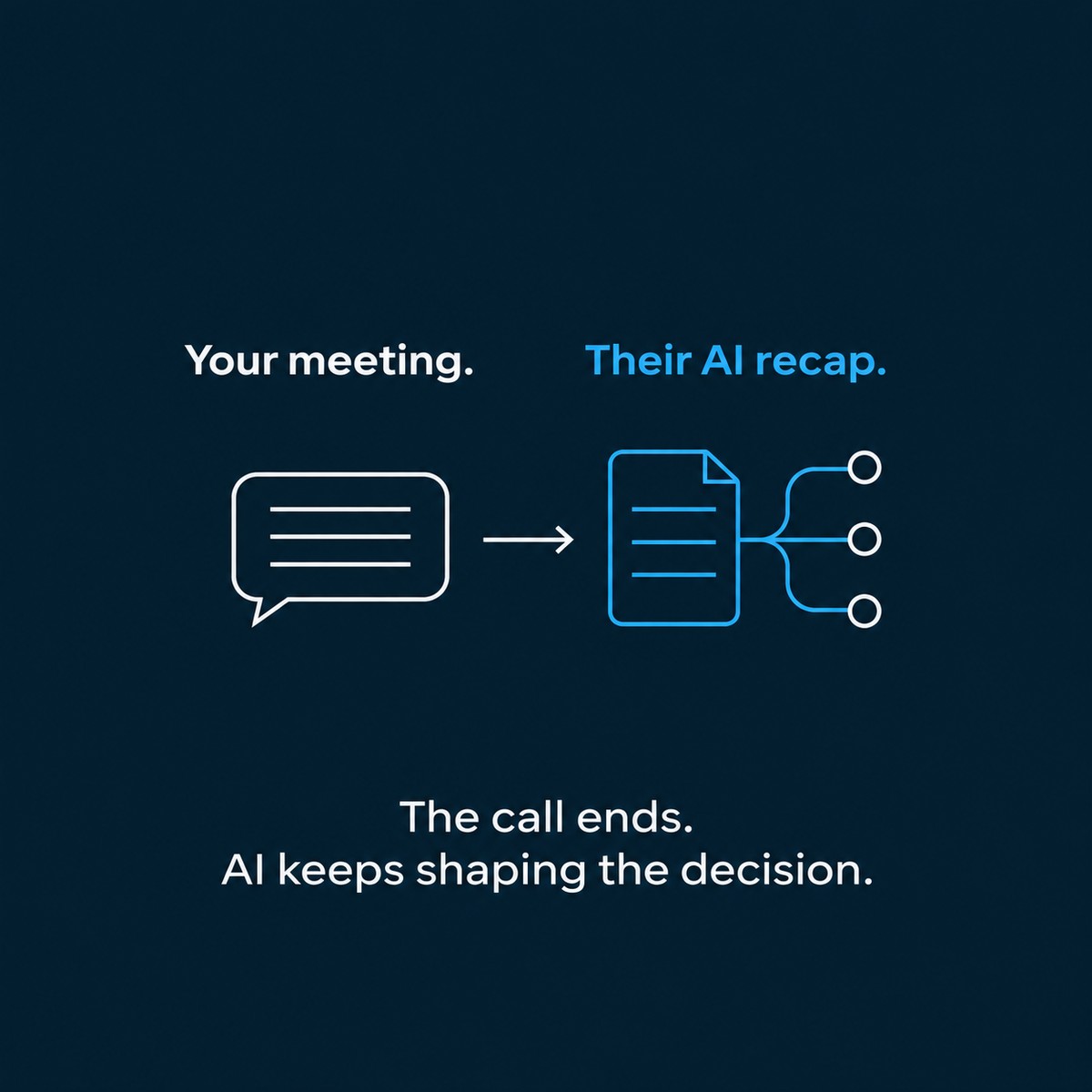
The sales meeting is no longer a private moment that disappears when the call ends. It is becoming machine-readable evidence that can be summarized, challenged and reused throughout the decision.
Your meeting now creates a decision asset
For years, sales conversations had a useful half-life. Buyers took imperfect notes. Important details were forgotten. Nuance stayed with the people who attended. A confident salesperson could clarify an objection in the moment and keep the conversation moving.
AI changes that. The call can become a transcript, a recap, a list of unanswered questions, a collection of claims to verify and a briefing for everyone who missed it.
Insivia’s AI sales training prepares sales teams for conversations that are being captured, checked and reinterpreted in real time.
This is already possible. Microsoft documents that Copilot in Teams can reason over a meeting discussion and chat, produce custom summaries, identify unresolved questions and answer questions from the transcript after the meeting. This is not a distant prediction about autonomous buyers. It is available meeting infrastructure.
AI changes the meeting before, during and after it happens
| Stage | What the buyer can do with AI | What changes for the seller |
|---|---|---|
| Before | Research your company, compare alternatives, expose likely risks and generate sharper questions. | The buyer arrives with a frame already formed instead of waiting for your discovery process. |
| During | Capture the transcript, summarize claims, flag open questions and surface competing perspectives. | Ambiguity, inconsistency and unanswered questions become durable parts of the record. |
| After | Compare answers, test claims, model tradeoffs and brief stakeholders who never joined the call. | The AI-generated interpretation can travel farther than the original conversation. |
The summary may matter more than the conversation
A salesperson can give a nuanced answer with confidence, context and charisma. The AI recap may reduce it to one sentence. A valuable caveat can disappear. An evasive answer can become the central issue. A decision-maker who was not there may only see the generated version.
Research into LLM-powered meeting recaps shows their potential to improve shared understanding while also identifying the challenge of producing summaries that preserve what is personally relevant to different participants. The summary is useful precisely because it compresses the conversation. That compression is also where meaning can change.
The meeting is no longer the final version of what happened. The AI-generated interpretation may become the version that travels.
In The Omniscient Buyer, I put the lost window of influence this way:
“You once had time to shape perception, build trust, and respond to questions before they hardened into decisions.”
— Andy Halko, The Omniscient Buyer
Charisma is being separated from the claim
Great salespeople use tone, timing and rapport to make difficult ideas understandable. That still matters. But after the call, AI can isolate the statement from the person who delivered it.
“We are easier to implement” becomes a claim to compare. “Our support is better” becomes a request for evidence. “We are more strategic” becomes an invitation to ask what that actually means.
This raises the value of specificity. It rewards direct answers, measurable proof, explicit limitations and a point of view that stays intact when the personality is removed.
The invisible audience is bigger than the meeting
Your salesperson may believe they are speaking to four attendees. The transcript and recap may later reach finance, procurement, legal, technical evaluators, executive leadership and another AI system used to compare proposals.
Those audiences did not hear the tone. They did not experience the rapport. They may not know why a caveat was important. They receive a compressed artifact and use it to make a decision.
Capture
The conversation becomes a transcript that can be searched and reused.
Interpret
AI decides what appears important, unresolved or inconsistent.
Distribute
The interpretation reaches people who never heard the original exchange.
Reuse
The meeting becomes input for comparisons, verification and the final recommendation.
Sales teams have to prepare for the meeting after the meeting
- Assume every important call may be transcribed. Speak as if every claim will be extracted and reviewed later.
- Answer the question directly. Give the clear answer before adding context or qualification.
- Make important claims measurable. Vague superiority will collapse inside a comparison.
- State limitations yourself. Credible boundaries build more trust than forcing the buyer’s AI to uncover them.
- Send your own recap. Give the buyer an authoritative reference instead of surrendering the entire interpretation to the machine.
- Attach proof to the claims most likely to be checked. Do not make the buyer rebuild your case.
- Keep the story consistent. Your salesperson, website, proposal and customer evidence should survive cross-examination together.
- Prepare for the questions that come later. The buyer’s hardest questions may arrive only after AI analyzes the call.
You are speaking to the buyer—and the system beside them
AI does not have to interrupt the call to change it. It can listen quietly, package what happened and influence everyone who enters the decision afterward.
That means the standard is rising. A strong conversation must also produce a strong record. Your argument has to remain clear after it is summarized, credible after it is verified and differentiated after it is compared.
Insivia’s guide to AI sales experiences shows how buyer-facing tools can carry the argument forward when the live conversation is over.
Because the meeting no longer ends when everyone hangs up. That is when the buyer’s AI may begin deciding what the meeting meant.
Build an argument that survives AI interpretation.
Explore the full shift in The Omniscient Buyer, bring this topic to your sales leadership team or see how AI-influenced buyers may interpret your company through BuyerTwin.

