The Augmented Human
Right now, companies are obsessed with implementing AI so their teams can work better, faster or cheaper.
They are buying tools, redesigning workflows and asking every department to find new efficiencies. That work makes sense. But it is also keeping companies focused almost entirely on what AI is changing inside their own walls.
What they are missing is that their buyers—the people they are trying to reach, convince and retain—are using AI to research markets, compare options, challenge company claims and decide who deserves their business.
Spending millions to make employees more productive with AI while ignoring how fundamentally AI is changing your potential and current customers is a path to failure.
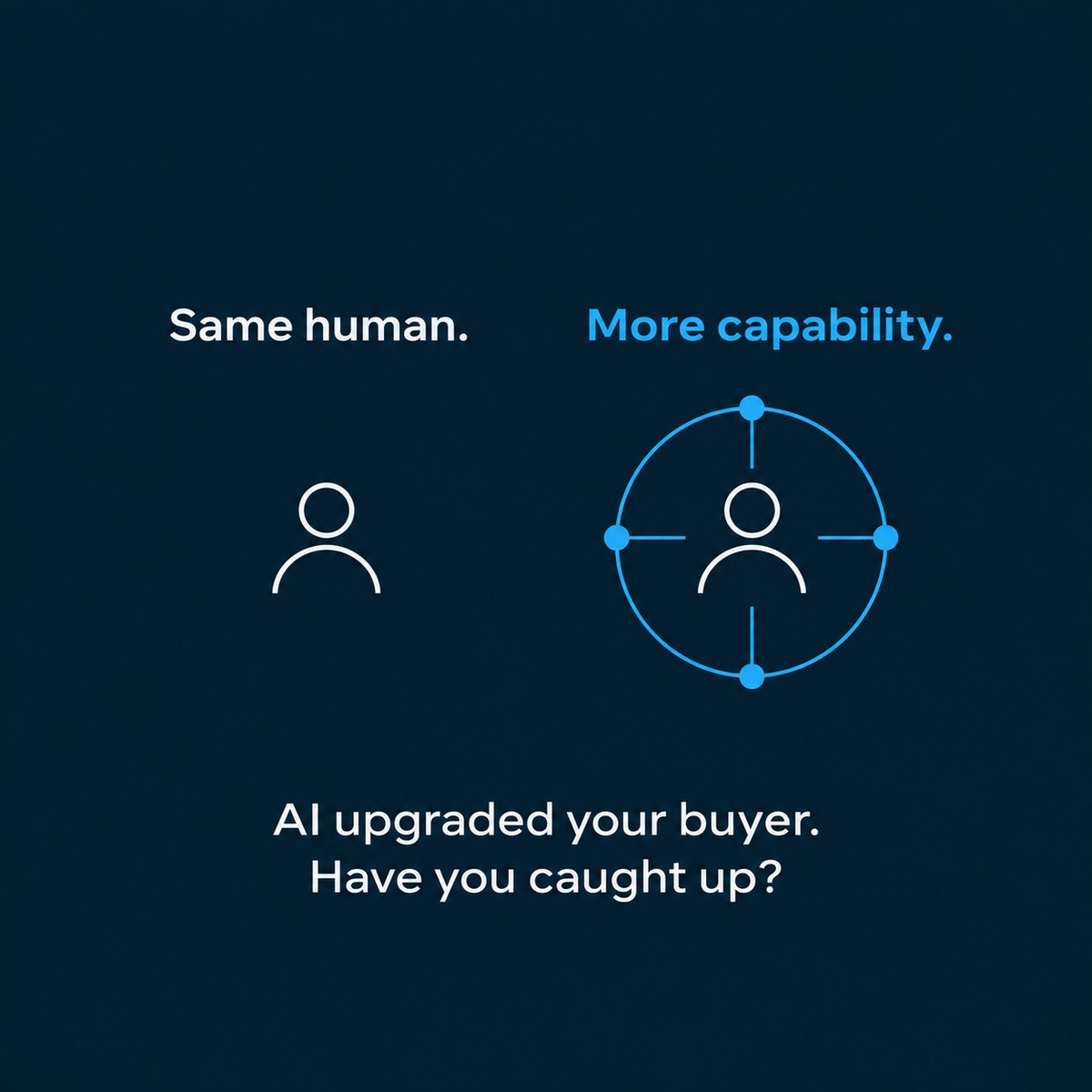
A working definition
An augmented human is a person whose ability to understand, compare, create and decide has been expanded by artificial intelligence.
I use the term augmented human because AI is not replacing the buyer. It is giving the buyer capabilities they did not have before.
A person can now ask AI to explain an unfamiliar market, identify dozens of alternatives, build evaluation criteria, compare competing claims and prepare a recommendation. Work that once required a research team, several vendor conversations and a tolerable amount of corporate archaeology can now happen in an afternoon.
That does not mean the work is always accurate. AI can produce outdated information, weak assumptions and confident nonsense. But even imperfect AI changes what a buyer can do, how quickly they can do it and how prepared they feel when they finally speak with a company.
The buyer has not disappeared. The buyer has been upgraded. Most marketing and sales organizations have not.
How the augmented buyer behaves differently
The traditional buying journey assumed that companies controlled access to expertise. A buyer searched for information, found a few possible vendors and contacted them to learn what they did not yet know.
AI breaks that sequence. The buyer can now learn, compare, question and eliminate options without ever raising their hand. By the time they appear in a CRM, they may already have a working theory of the market and a strong opinion about who belongs on the shortlist.
| Before augmentation | The augmented buyer |
|---|---|
| Searches for individual sources | Asks for a synthesized explanation |
| Builds a shortlist manually | Generates and revises a candidate set |
| Relies on vendors for education | Arrives with a preformed understanding |
| Compares a manageable number of options | Compares many options at little incremental cost |
| Develops criteria during conversations | Arrives with AI-generated criteria |
| Verifies claims after the meeting | Can verify claims during or immediately after it |
| Signals intent through visible research | Conducts extensive research invisibly |
| Depends on personal expertise | Borrows language, frameworks and confidence from AI |
This is not a prediction about some distant world of autonomous purchasing agents. It is already showing up in how people research and make decisions. McKinsey’s 2026 agentic-commerce research found that AI users were almost twice as likely to begin purchase research with AI-based search. Nearly one-third of surveyed AI shoppers said AI chat or search had the greatest influence on their most recent purchase.
Microsoft and LinkedIn’s Work Trend research found that AI power users are more likely to analyze information, solve problems, experiment and redesign workflows. Buying is a knowledge workflow too. It will not be the one workflow AI leaves alone.
The capabilities companies are underestimating
AI does not give the buyer one new trick. It gives them a stack of capabilities that build on one another. Access leads to synthesis. Synthesis makes simulation possible. Simulation leads to stronger decision support.
None of these capabilities guarantees a better decision. Put them together and you get a buyer who can move faster, examine more options and enter a sales conversation far more prepared than most companies expect.
Four ways the old buying process is breaking
1. Information is becoming synthesis
Buyers no longer need to gather and organize every source themselves. They can ask AI to explain a market, identify alternatives and turn scattered information into a coherent point of view.
That takes away an advantage companies have relied on for decades. If your sales process begins by educating the buyer about information they already synthesized last week, you are not leading the conversation. You are catching up to it.
This is why your informational edge over buyers is disappearing and why more buyer questions are going to AI before they ever reach you.
2. Lower effort gives buyers more leverage
Research that once consumed days can be compressed into minutes. Buyers can explore competitors, switching scenarios, implementation risks and objections without scheduling a call or creating a visible signal of intent.
Companies often interpret a lack of visible activity as a lack of interest. That assumption no longer holds. A serious buyer may be doing extensive work while remaining completely invisible to your analytics and sales team.
That is the consequence of the collapse of friction: buyers can investigate more while revealing less.
3. Fluency can look like expertise
AI gives inexperienced buyers the vocabulary, frameworks and questions of an expert. That can create a better conversation, but it can also create confidence that has not been earned through experience.
A buyer may sound certain because AI gave them a polished explanation. They may also be working from faulty assumptions they did not create and do not know how to question. Companies that dismiss them will lose trust. Companies that simply agree with them may walk straight into a bad decision.
Synthetic expertise and artificial confidence force sellers to do something harder: respect the buyer’s preparation while still testing the thinking underneath it.
4. The individual is becoming a human–AI decision system
The buyer still makes the decision, but they increasingly make it with AI beside them. AI helps frame the problem, define criteria, organize evidence, test objections and prepare a recommendation.
Microsoft’s 2025 Work Trend Index describes the movement from a human with an assistant toward human–agent teams. OpenAI’s research on agents shows people delegating longer, multi-step knowledge tasks.
Put this together and you get the AI co-decision maker. Your competitor is no longer only another company. It is also the explanation, comparison and recommendation the buyer’s AI has already produced.
Augmented does not mean accurate
AI can confidently present incomplete, outdated or incorrect information. It can build criteria around hidden assumptions, repeat weak claims and make a buyer feel certain when they should still be asking questions.
Some companies will use those mistakes as evidence that AI-influenced buying is overhyped. That misses the point. The buyer does not need perfect AI for their behavior to change. They only need AI that makes research easier, comparison faster and preparation more accessible.
Companies are no longer competing only for the buyer’s attention. They are competing with the interpretation the buyer’s AI has already created.
Telling a prepared buyer that they are wrong will not work. Neither will repeating a sales pitch and hoping it overpowers what they already believe. Companies need to understand how the buyer reached a conclusion, find the assumptions underneath it and bring evidence strong enough to survive independent verification.
What companies need to do now
The answer is not to publish more generic content or add an AI chatbot to the website. Companies need to make their expertise easier for both people and AI systems to find, understand, compare and trust.
Insivia’s work on AI buyer evolution explores how organizations can adapt marketing and sales around these behaviors. BuyerTwin helps teams see how different buyers interpret their messaging, criteria and choices before those opinions harden into a decision.
Questions leaders are asking
What is an augmented human?
An augmented human is a person whose ability to understand, create, compare or decide has been expanded by artificial intelligence.
How does AI augment buyers?
AI helps buyers synthesize information, compare more options, generate evaluation criteria, test claims, model risks and prepare questions before contacting a vendor.
Does an AI-augmented buyer make better decisions?
Not automatically. AI improves access, speed and analytical capacity, but it can also introduce errors, bias and false confidence. Human judgment remains responsible for the outcome.
How should companies respond to AI-augmented buyers?
Companies need to publish extractable expertise, provide verifiable evidence, anticipate preformed opinions and design marketing and sales experiences for decisions made by people working with AI.
Prepare for the augmented buyer
The buyer changed while most companies were looking inward.
AI is not only changing how your company works. It is changing the person your company must persuade. Companies that see this now still have time to adapt. Companies that do not will keep improving systems built for a buyer who no longer exists.
Explore The Omniscient Buyer Book Andy to Speak Explore BuyerTwin

