You Can Lose the Deal Before the Buyer Ever Visits Your Website
Your analytics can show zero interest from a buyer who has already compared your company, found a weakness and removed you from the shortlist.
No visit. No form fill. No conversation. Not even a signal that the opportunity existed.
That is the part of AI-influenced buying companies are not prepared for. Buyers can ask AI who belongs in the market, apply a few constraints and cut the list before any vendor knows the deal is real.
You are not just losing visibility into the buying journey. You can lose the deal before your systems know there was a buyer.
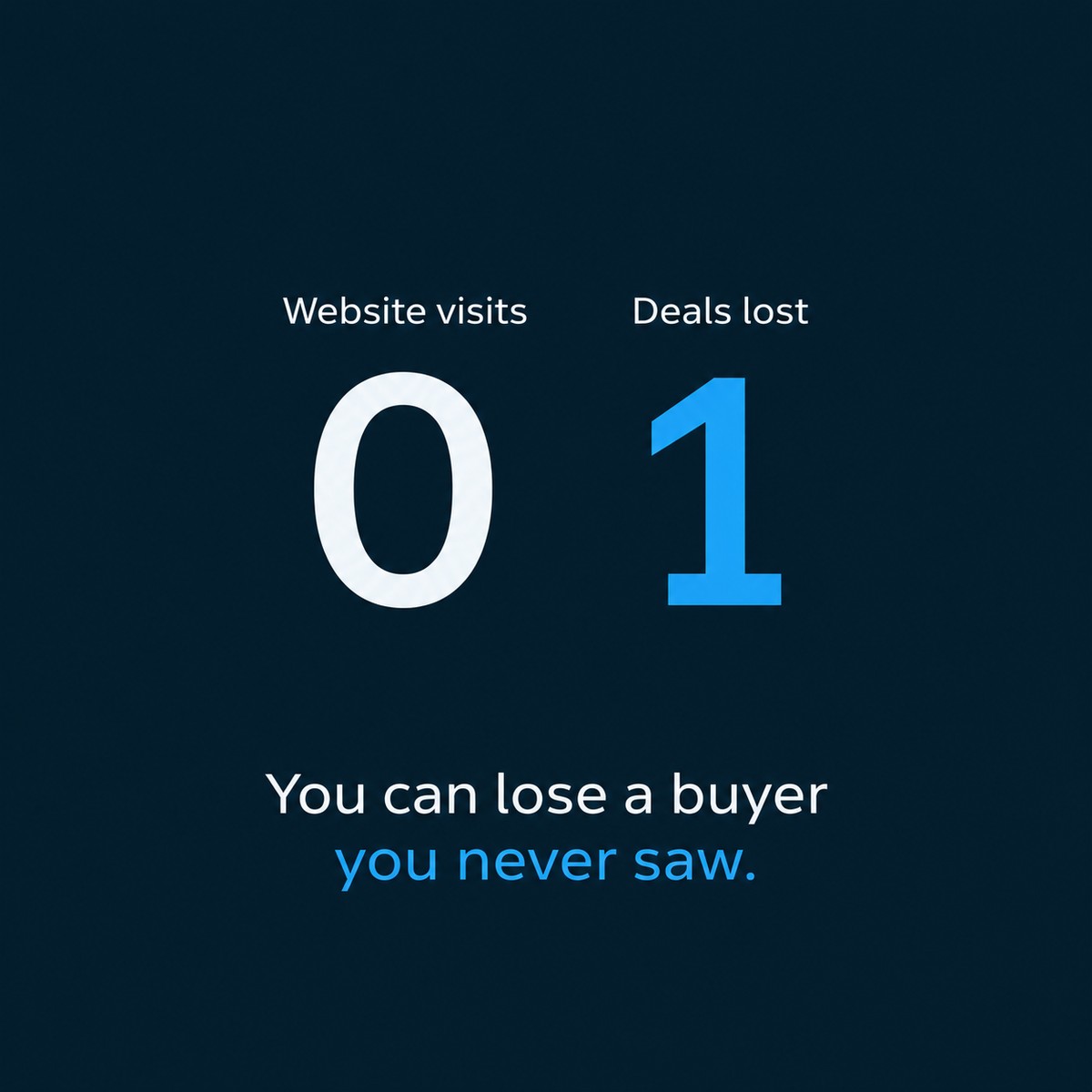
A website visit may no longer mean the buyer has started evaluating you. It may mean you survived long enough to be checked.
The buyer does not need your website to build the market
Vendor discovery used to create footprints. Buyers searched, opened websites, downloaded material and talked to sales while they tried to understand the category. Even if they eventually chose someone else, companies could see at least part of the evaluation taking shape.
AI lets the buyer start somewhere else entirely.
They can describe the problem in their own language and ask which companies are worth considering. They can request options for an organization of their size, filter for industry experience, remove vendors without a required integration and ask which three choices carry the least risk.
The buyer may never begin with your category name. They may never mention your company. AI has to decide what kind of market the buyer is describing, which companies belong in it and whether your company fits the situation well enough to appear.
That creates a new competitive threshold. Before you can be compared, you have to become part of the candidate set.
The invisible elimination funnel
The broader consideration stage has become a private elimination round. This is how a company disappears inside it.
Problem interpretation
AI decides what kind of problem the buyer is describing and which categories or approaches could address it.
Candidate generation
It assembles direct vendors, specialists, adjacent solutions, internal-build options and whatever else appears credible.
Eligibility filters
The buyer adds company size, industry, geography, budget, integrations, security, compliance and other constraints.
Credibility testing
AI looks for proof, reviews, customer outcomes, clear claims and consistency across the sources it can retrieve.
Shortlist compression
Unclear, risky, poorly matched or weakly supported companies disappear as the buyer keeps narrowing the answer.
Website confirmation
The surviving vendors finally receive a visit, inquiry or conversation so the buyer can validate what AI already assembled.
This process does not have to be perfectly accurate to determine who gets a chance. It only has to make one company look less appropriate, less credible or harder to understand than the alternatives.
Insivia’s answer engine optimization work helps companies avoid disappearing during AI-assisted vendor discovery, while its go-to-market consulting clarifies the market position buyers and AI systems encounter.
Once the candidate set exists, the buyer can rebuild the vendor comparison in seconds. Companies can be added, reranked or removed without any of them knowing the evaluation is changing.
The follow-up prompts do the cutting
The first AI answer is rarely the final shortlist. Buyers improve the answer by adding the details that matter to their situation, and every new constraint creates another opportunity for a vendor to disappear.
| What the buyer asks | What changes | How a vendor disappears |
|---|---|---|
| “Which companies can solve this problem?” | AI creates the initial market and chooses which types of solutions belong | The company is not connected clearly enough to the buyer’s problem to be included |
| “Only include vendors experienced with companies our size.” | The list is filtered for customer fit and relevant experience | The company never publishes who it serves or provides no proof for that segment |
| “Remove anyone without these integrations.” | A concrete technical requirement becomes an elimination rule | Missing or outdated integration information gets interpreted as lack of support |
| “Which options have credible proof in our industry?” | Claims are tested against customer evidence and outside validation | Generic testimonials cannot support the specific claim the buyer needs to defend |
| “Give me the three safest choices.” | The field is compressed around risk, reputation and explainability | Uncertainty becomes risk, even when the company may actually be the stronger choice |
None of those prompts is unreasonable. Together they can remove most of the market before a salesperson has the opportunity to explain a missing detail, challenge the criteria or correct a bad assumption.
Buyers are already building shortlists this way
Wynter surveyed 200 B2B buyers who had recently used AI to research a software or service vendor. Sixty-two percent opened with a category question that named no vendor, even though 80% already had at least one company in mind.
AI was not simply confirming an existing list. Sixty-seven percent said it introduced a vendor they had not considered that made the shortlist. Three-quarters continued for at least three follow-up messages, where pricing, integrations, implementation, reviews, security and other requirements started cutting the field.
Then 72% visited vendor websites after the AI conversation.
Read Wynter’s study on how B2B buyers research vendors with AI.
The sequence matters. The website often receives a buyer after AI has already created the market, introduced alternatives and applied the first filters. The visit is a validation step for a company that survived.
Magenta Associates found the same connection between discovery and disqualification. Two-thirds of UK decision-makers were already using AI to research or evaluate suppliers, and 85% of those users had discovered a new product or vendor through an AI-generated response. But 71% of decision-makers said they would dismiss a supplier that lacked clear, transparent information, while 69% would dismiss one because of poor reviews or reputation.
Review Magenta Associates’ research on AI in the B2B buyer journey.
Getting mentioned is not the same as surviving. AI may add the company to the list, but unclear information and weak credibility can remove it just as quickly.
Your company can be visible to AI, included in the first answer and still disappear before the buyer becomes visible to you.
What gets a company eliminated
Companies rarely disappear for one dramatic reason. They disappear because AI cannot answer the next practical question with enough confidence.
| Elimination reason | What AI encounters | What the company must supply |
|---|---|---|
| Unclear category | It cannot confidently determine what the company does or which problem it solves | A direct category, problem and approach definition |
| Weak buyer fit | Industry, company size, use case or operating context is missing | Explicit ideal-customer language and relevant examples |
| Missing qualification details | Pricing, integrations, geography, implementation or compliance cannot be confirmed | Current and structured qualification information |
| Unsupported claims | Differentiation sounds attractive but cannot be validated | Evidence connected directly to each important claim |
| Conflicting information | The website, directories, reviews and old content tell different stories | Consistent facts across authoritative sources |
| Poor reputation signals | Negative reviews, unresolved complaints or weak outside validation | Credible responses, customer proof and third-party authority |
AI will not always say that it lacks enough information. It may fill the gap with an assumption, rely on an outdated source or favor a competitor whose story is easier to retrieve and explain.
Silence is not neutral in an AI-generated shortlist. Missing information can become a reason to cut the company.
Your analytics no longer show the whole market
Marketing systems were built to observe actions: search impressions, website visits, downloads, form submissions, demo requests and conversations. An AI-mediated evaluation can create none of those signals until the buyer has already narrowed the field.
This does not make conventional analytics useless. It means they now show a later and incomplete portion of the decision.
A company can lose website traffic because buyers are getting more of the answer somewhere else. It can also maintain healthy traffic while quietly disappearing from the AI-generated consideration sets that matter most. Neither conclusion can be reached from traffic alone.
The new question is not only whether buyers reach the website. It is whether the company appears when buyers describe the problem, survives the filters they add and reaches the smaller group worth validating.
Build a company that survives invisible elimination
Become legible
State the problem, category, approach, buyer and use case in language the market actually uses.
Become qualifiable
Publish the concrete details buyers use to filter: fit, requirements, implementation, integrations, pricing context and boundaries.
Become provable
Connect outcomes, customer evidence, demonstrations and independent validation to the claims that determine inclusion.
Become consistent
Reconcile outdated and contradictory information across the website, profiles, directories, reviews and old content.
Become independently credible
Develop reviews, mentions and outside authority that do not depend on the company validating its own claims.
Test the elimination prompts
Run real buyer situations through multiple AI systems and watch exactly when the company enters, drops or gets described incorrectly.
The first conversation now starts after the first cuts
Companies still treat a website visit or sales inquiry as the beginning of consideration. Increasingly, it is evidence that the buyer has already built a list, applied constraints and decided the company deserves further investigation.
If the company survives, sales may enter after AI has already ranked the options. The salesperson is not meeting a buyer who needs the market explained from scratch. They are meeting someone who may already have assumptions, objections and a preferred choice.
If the company does not survive, there may be no signal to analyze and no lost opportunity in the CRM. There is simply a buyer who never arrived.
That is why AI visibility cannot stop at asking whether a model knows the company’s name. The real test is whether AI includes it for the right problems, can verify the details buyers use as filters and keeps it credible as the shortlist becomes smaller.
Getting found matters. Surviving the cut is what creates the opportunity.
Find out where your company disappears before the buyer arrives.
Explore the full argument in The Omniscient Buyer, bring the AI-influenced buying shift to your leadership team or use BuyerTwin to test the prompts, filters and evidence that determine whether your company survives.

